
Wooden Clamp Repair Build Process
 Return to main project page
Page 2 of 2
Posted 15th March 2026
Next up was the curved surface on the moving jaw. I roughed it out with a coping saw...
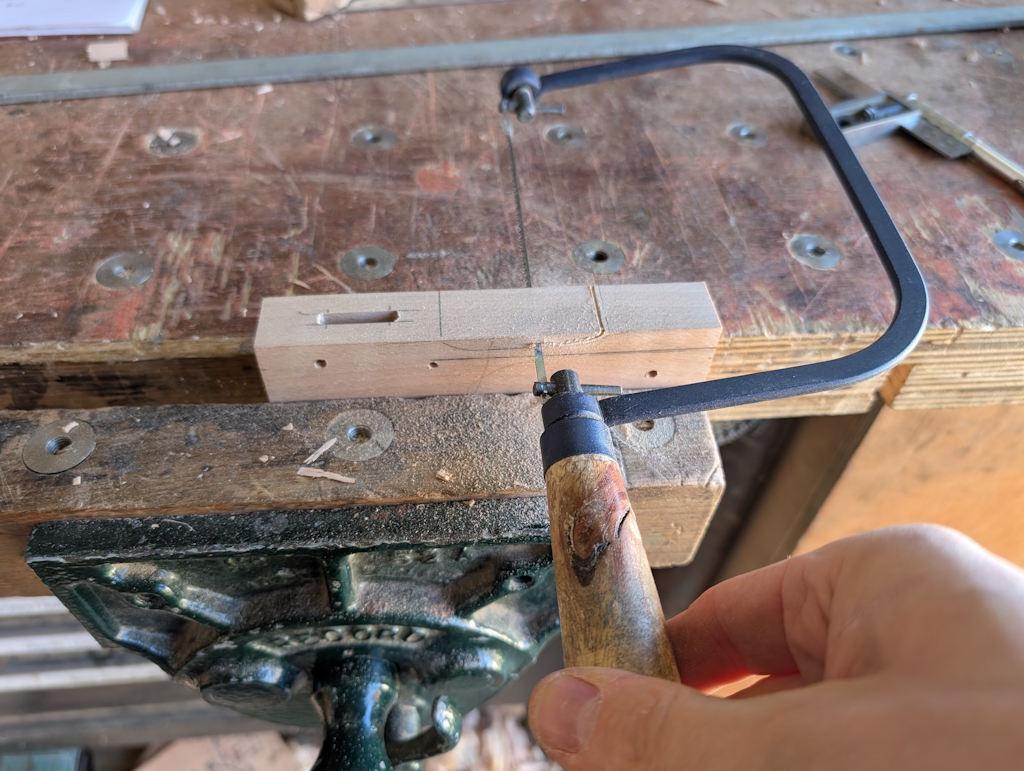
... then used a chisel bevel-up to get down to the line...
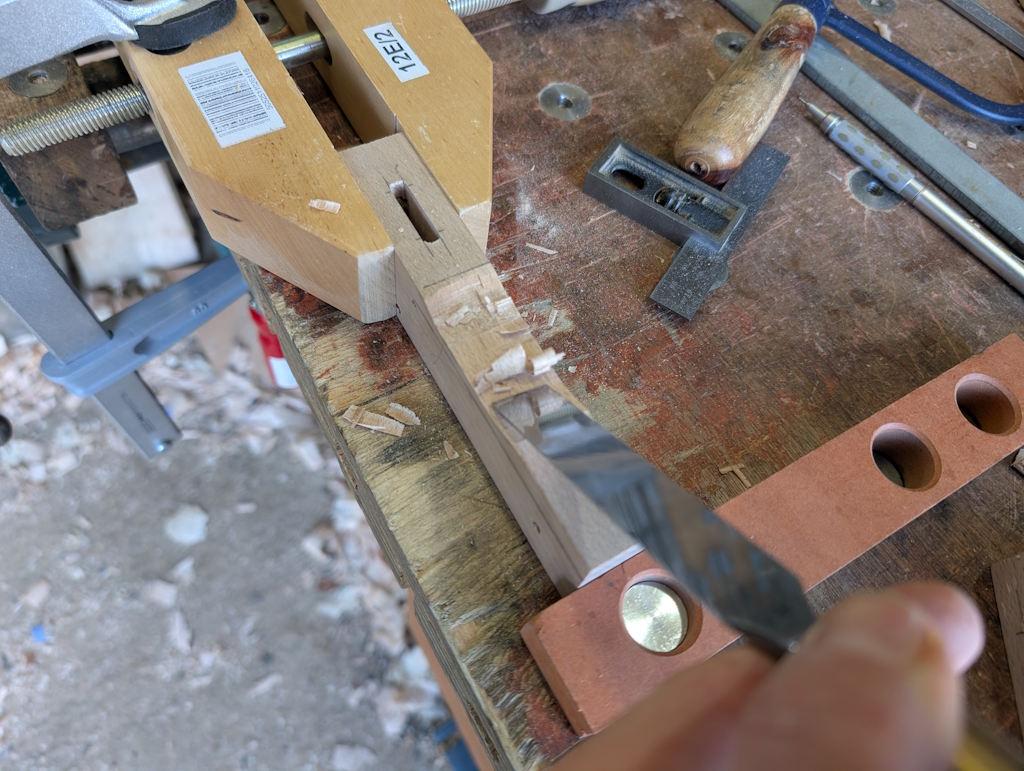
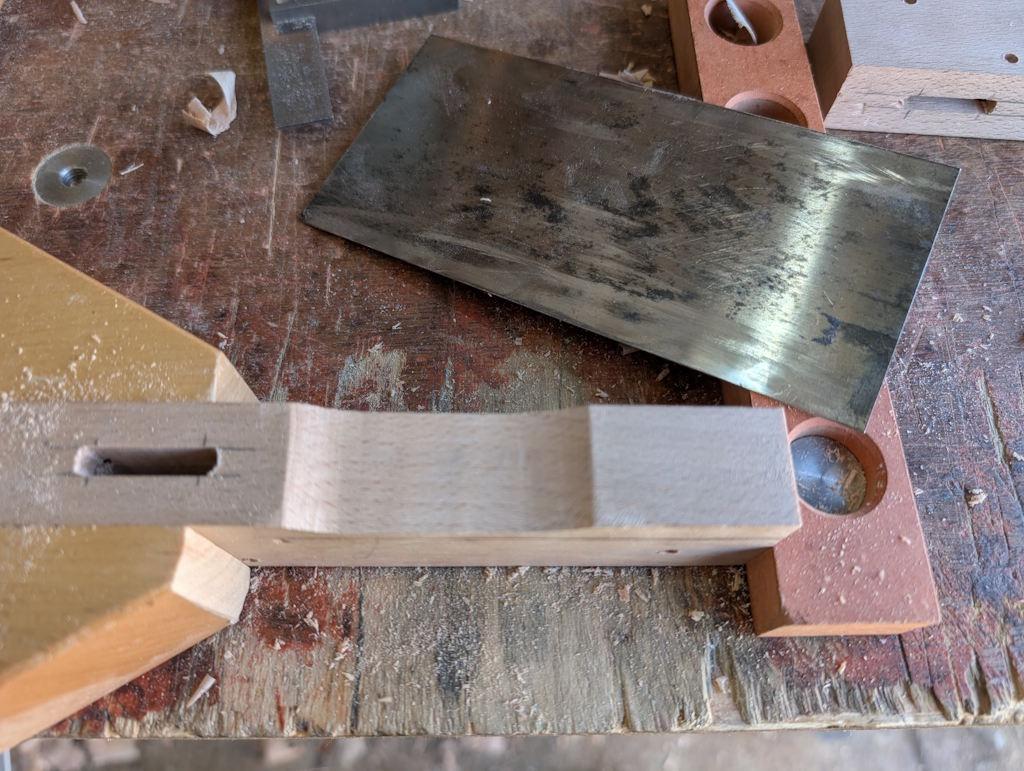
... then a card scraper to clean it up a bit:
I could then do the cut that I was most nervous about: the long saw cut to separate the moving part of the jaw from the fixed part:
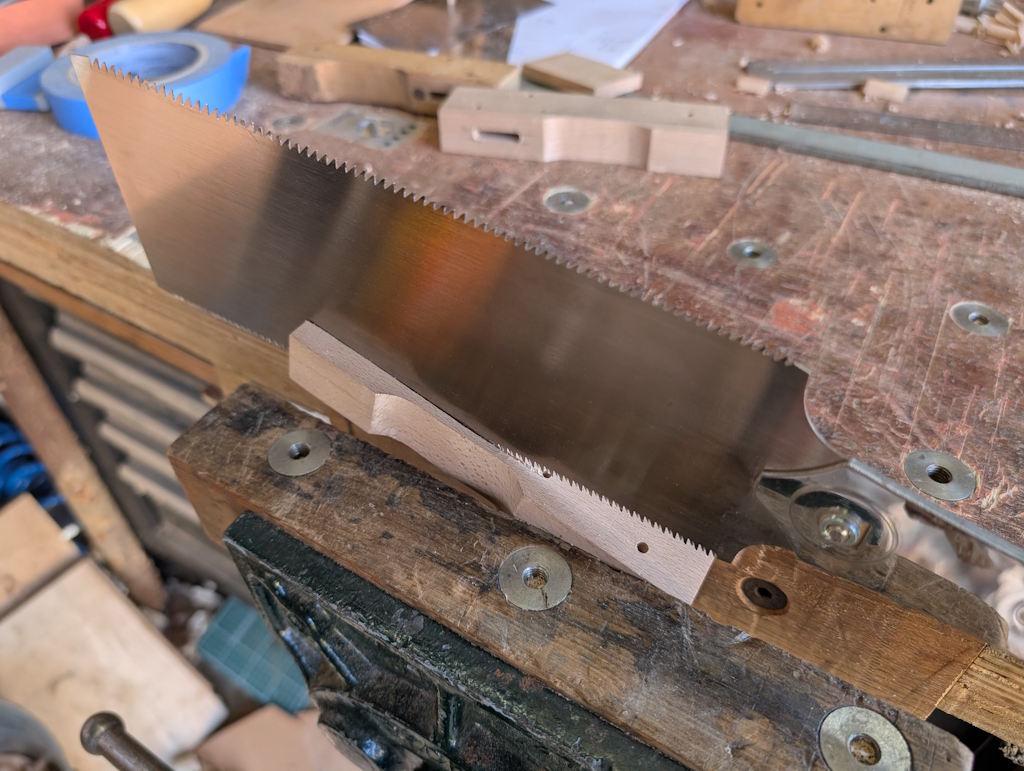
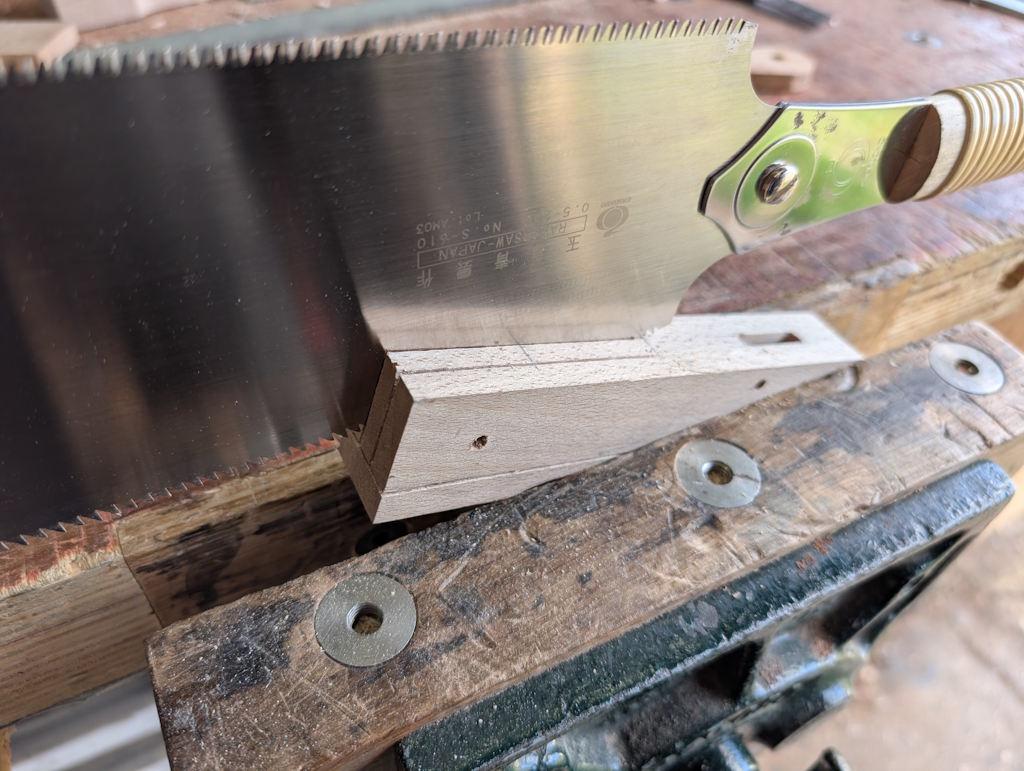
The eagle-eyed among you will notice that I did the first one with the cross-cut teeth of the Ryoba. On the second one I used the rip teeth, which unsurprisingly cut a lot better!
I was really, really happy with how the two slits went: following the line all the way to the edge of the relief hole.
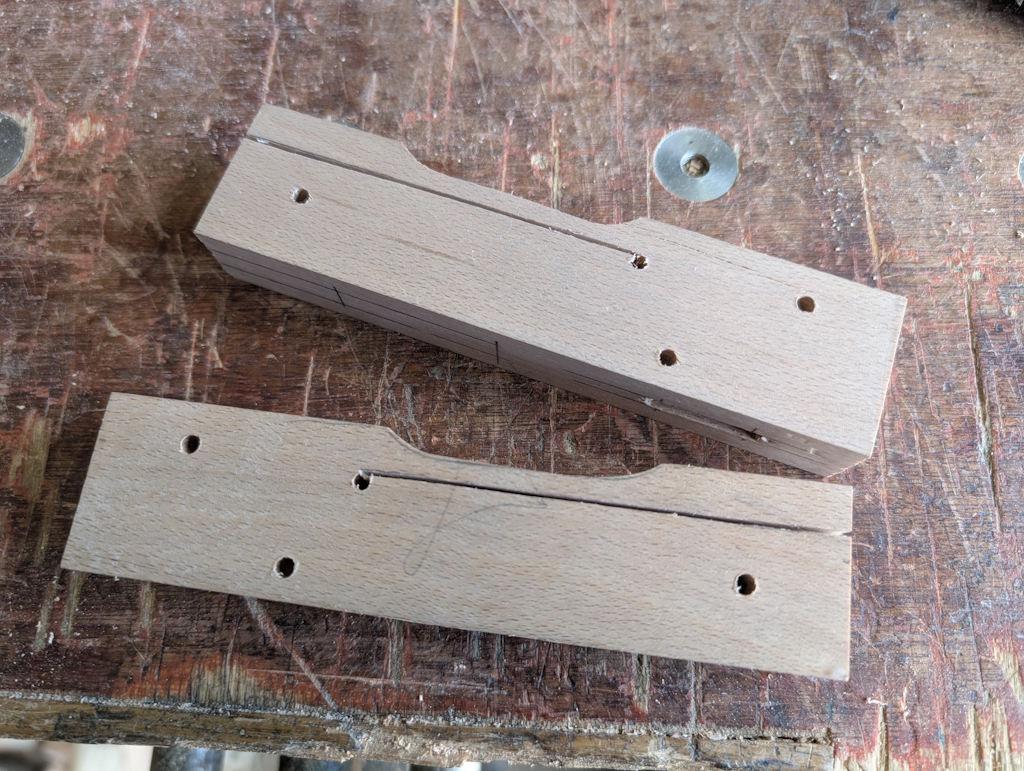
Just to be on the safe side, I opened the relief hole up (with the pillar drill) to 3.5 mm to make sure the slit and the hole met all the way through the block.
Next up was the open-ended mortice for the cam. On the original clamps, there's a curved surface at the back of the hole, probably as a result of it being cut with a table saw or equivalent. I neither have nor want a table saw and I'd rather do it by hand. I started by sawing down the pencil lines as far as I could:
There was then lots of chiselling. To minimise the chance of the chisel going through into the moving part of the jaw, I inserted some little 0.6 mm thick plastic shims into the saw kerf:
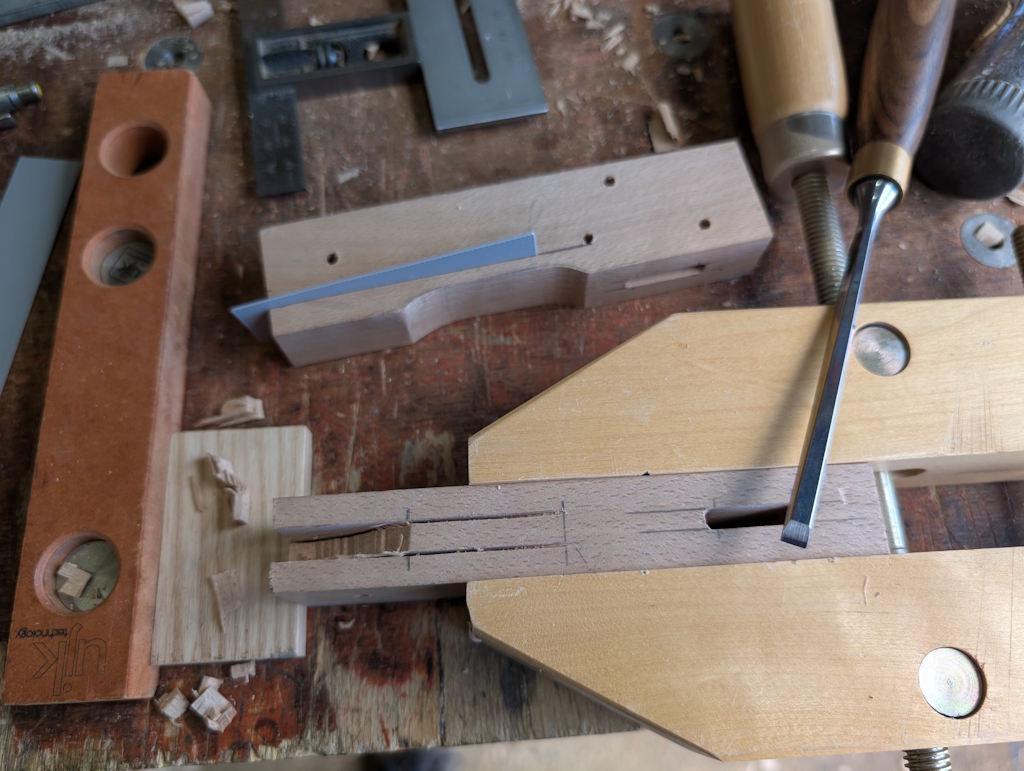
That worked really well: when the chisel met the shim, it would tend to push it along (and out of the slot) rather than going through it and into the moving part of the jaw. The last cross-grain cut was done with a little printed paring guide to give a nice smooth finish to the sloped edge of the mortice:
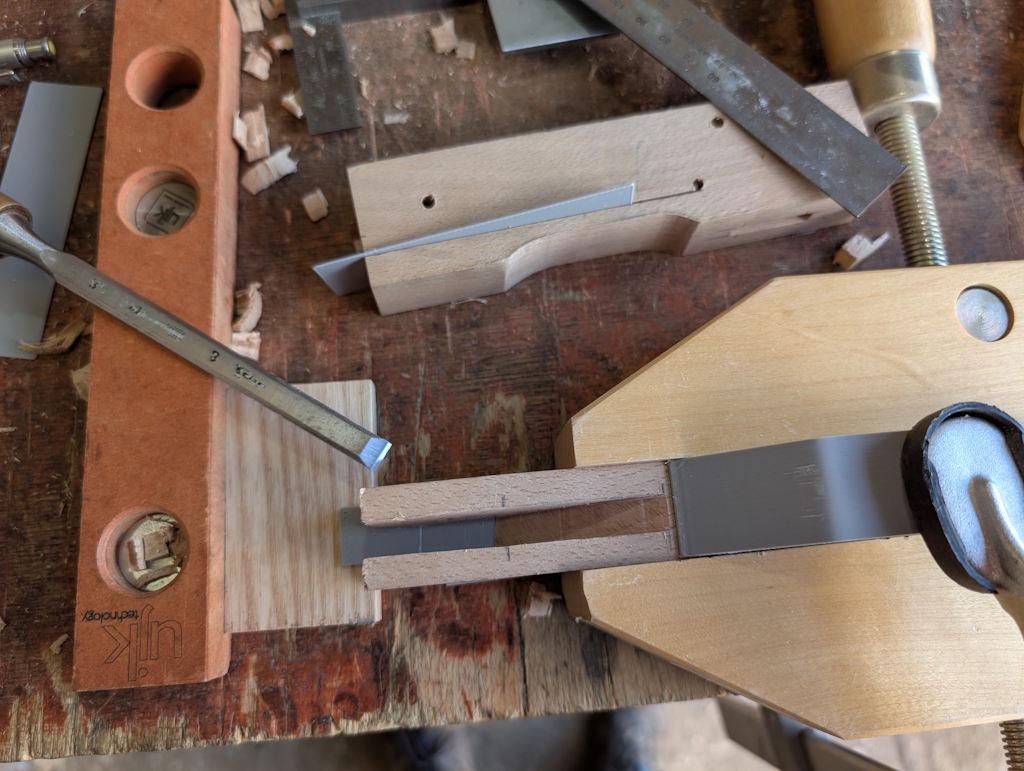
I'd cut that mortice as 8 mm wide, but the cams are 9 mm wide, so I then used an 18 mm chisel to pare the sides down until the cam was a nice smooth fit:
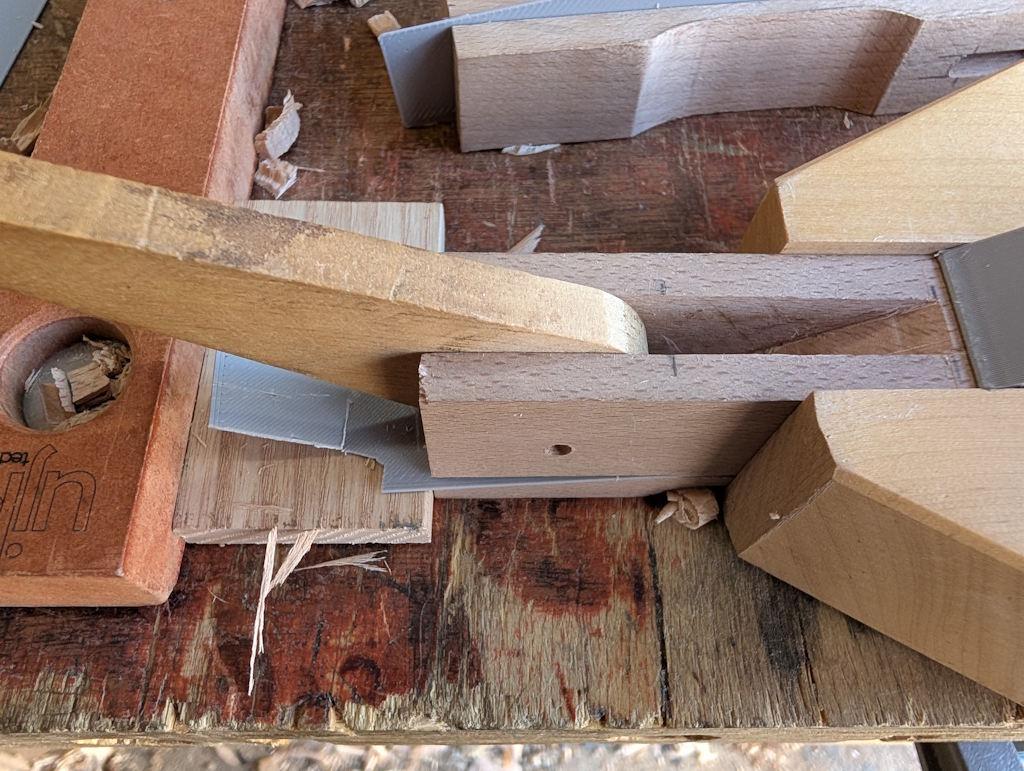
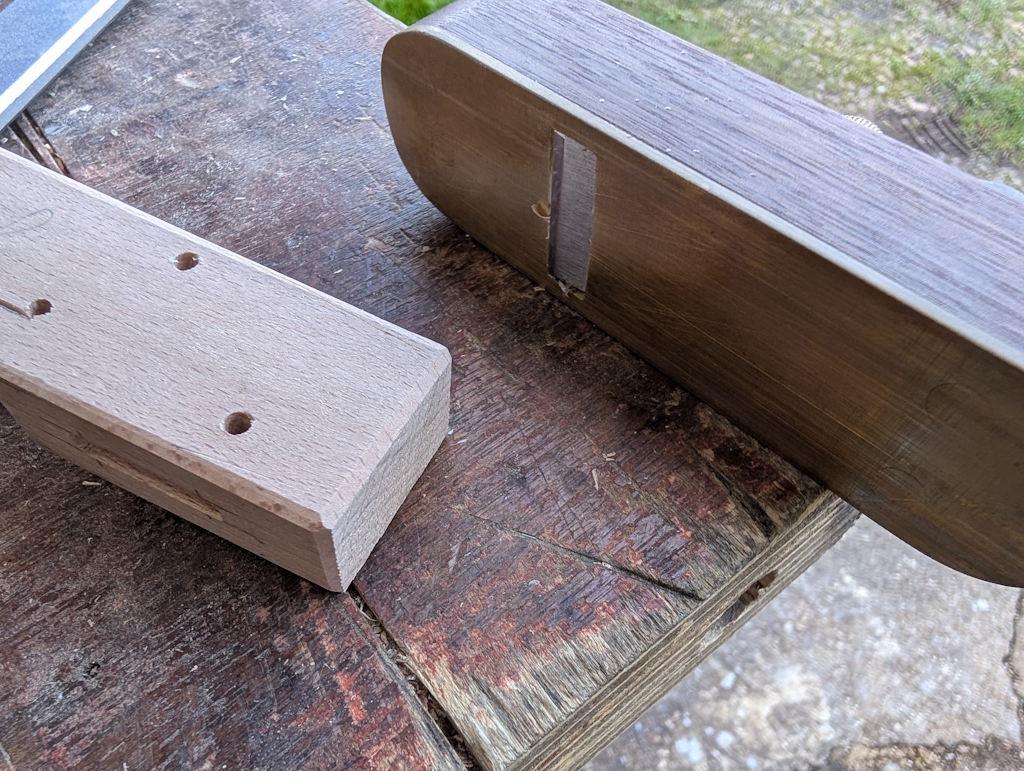
The edges then all got chamfered, using my home-made block plane for the straight edges and a thin card scraper for the curved ones:
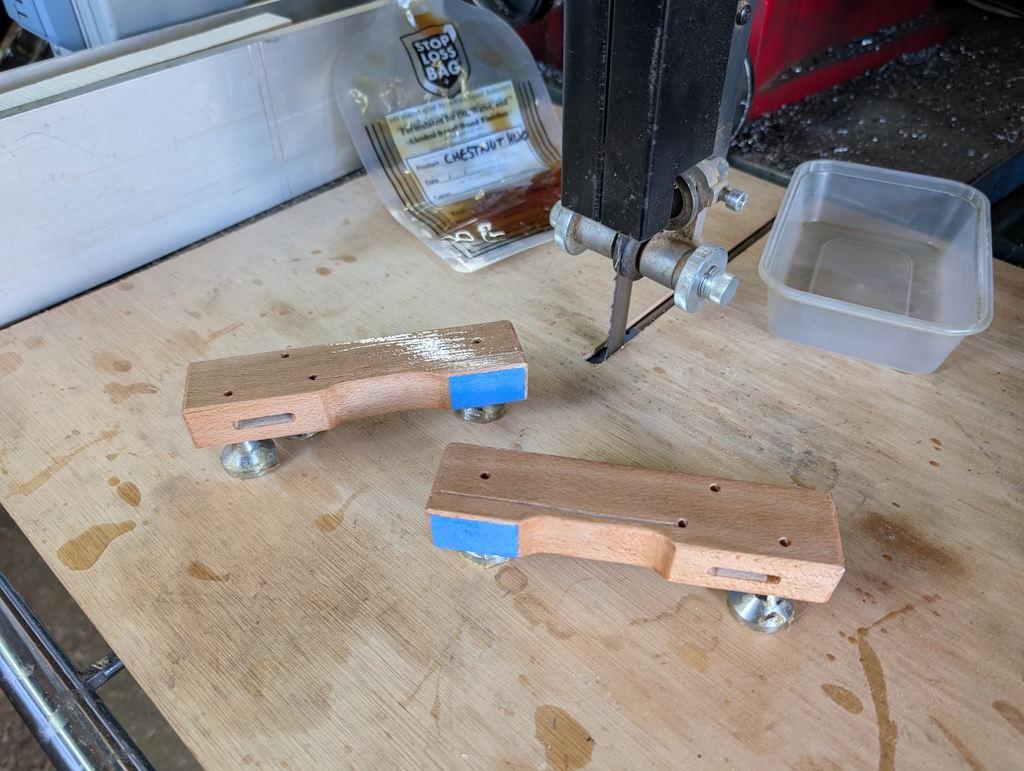
The plastic shims then got re-inserted into the saw kerfs, some masking tape applied to the clamping surfaces (which will get some cork stuck to them) and the bodies given a coat of hard wax oil:
The cams also got a bit of a clean-up with a card scraper, just taking the minimum off to remove some bits of dirt rather than trying to get an immaculate finish:
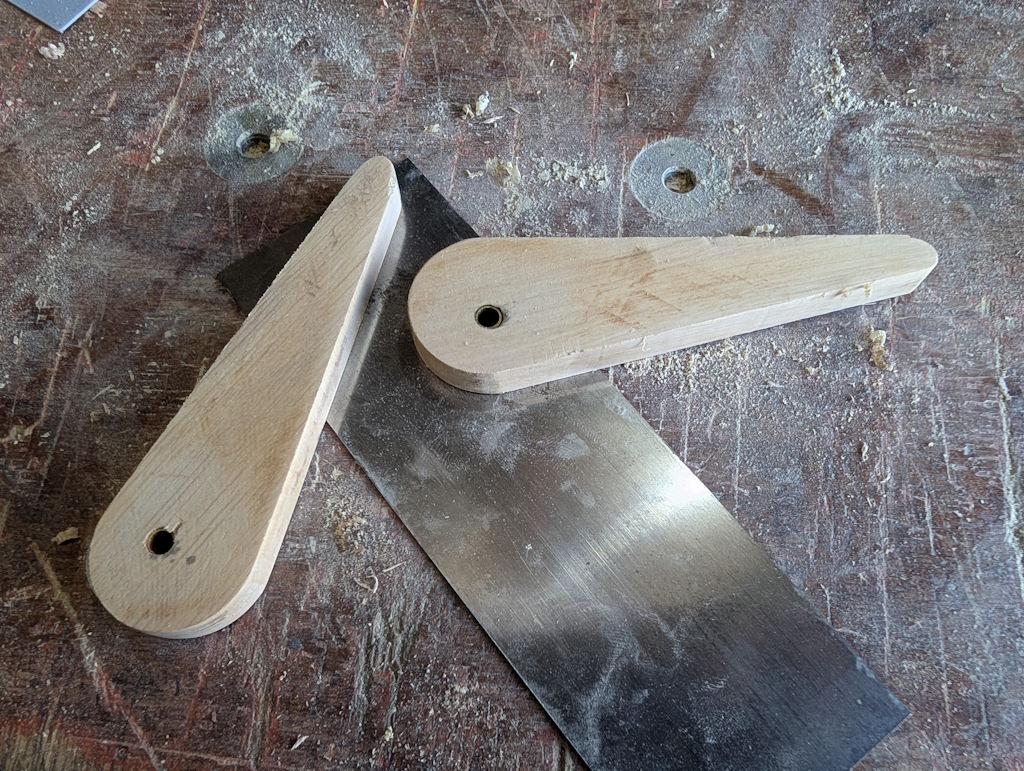
They also got some hard wax oil applied.
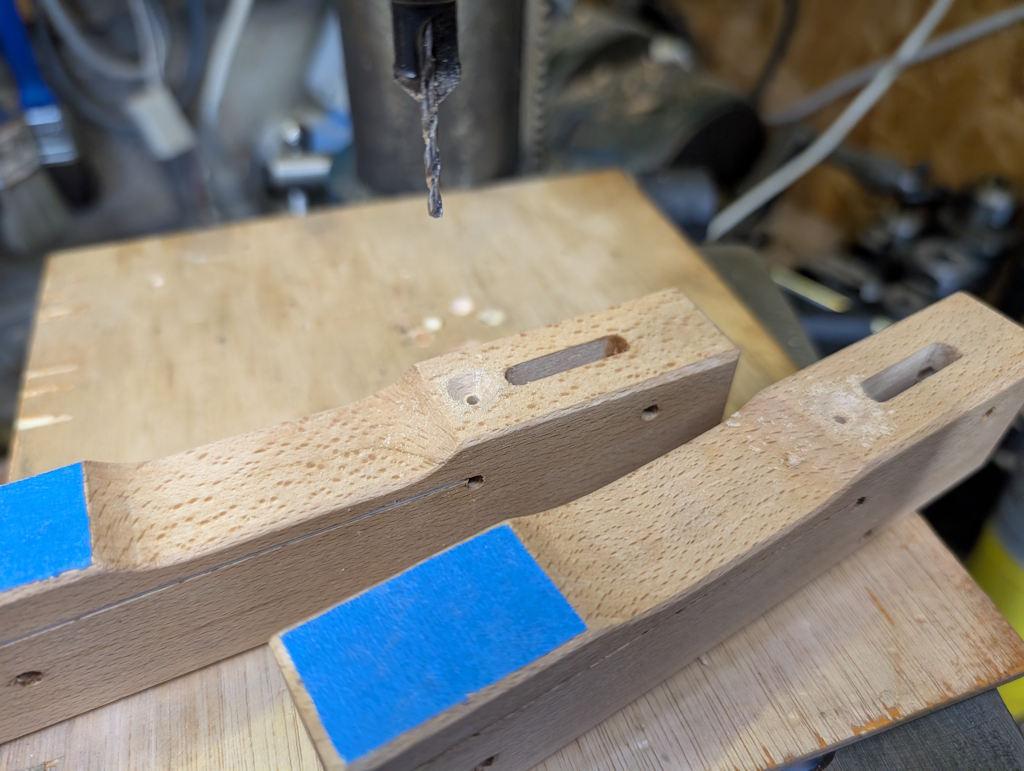
I realised after doing the first coat of oil that I still need to drill the hole for the reinforcing screw, so after the first coat of oil had dried, I used a combined pilot drill and countersink to drill a hole in the front face of each of the new clamp bodies:
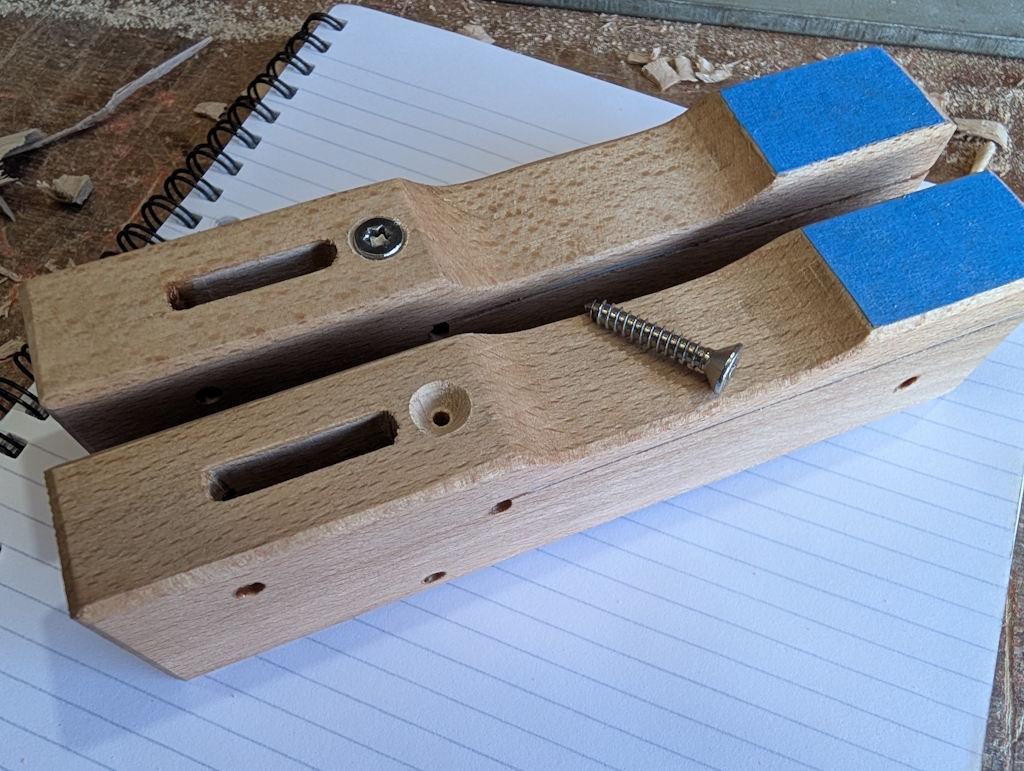
The original clamps had slotted screws but as far as I'm concerned slotted screws have no redeeming features whatsoever so there was no way I was going to use them in the repaired clamps. A couple of stainless steel Torx head screws will do nicely:
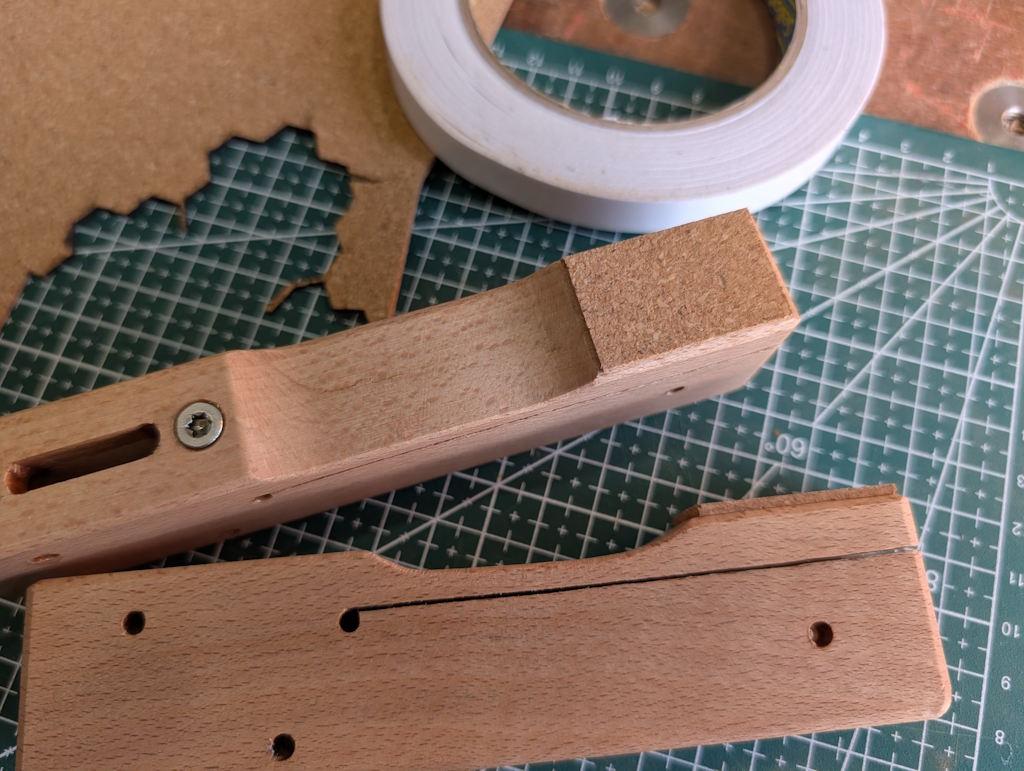
After the second coat of hard wax oil they were left overnight. This morning I removed the masking tape and used double-sided tape to stick some bits of thin cork onto the clamping faces:
I could then assemble the clamps. Despite putting all the roll-pins into a little tray to keep them together, I'd somehow managed to lose one of them. Fortunately, I had a cheap set of roll pins and that included one of the right diameter but much too long. I cut it down to length and used that to replace the missing one.
All the clamps together again:
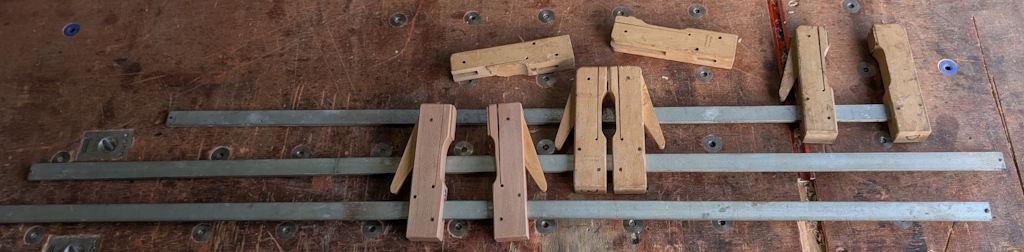
A close-up of the repaired clamp:
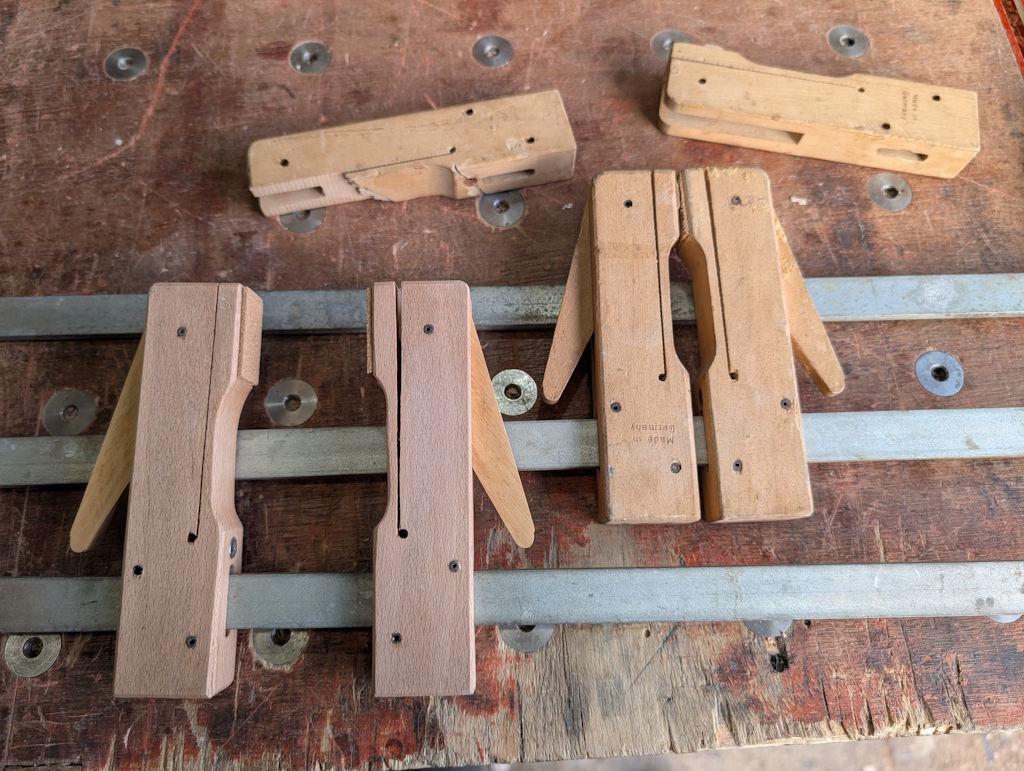
As you can see, one of the clamps has the cam pivot hole a little too close to the jaw slit so that even in the fully unlocked position the moving part is slightly out. I could fix that easily by reshaping the cam slightly, but it doesn't affect the function so I'm not going to worry about it.
I don't have an immediate need for these clamps, but I thought it would be good to do a rudimentary test by clamping onto a spare bit of wood:
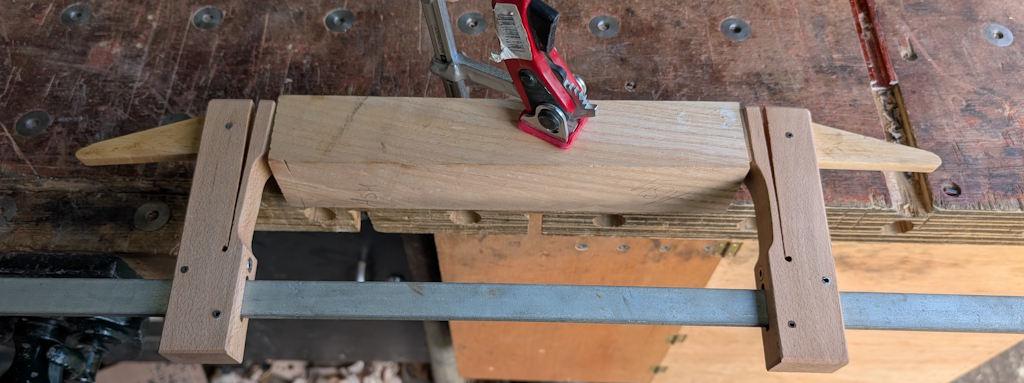
They hold their own weight (which is dominated by the long steel bar) well and didn't need much of the cam motion in order to do so. I think they'll be a useful addition to my clamping arsenal. Many, many thanks again to Graham for sending me these clamps and giving me this little project! Apart from sticking the cork on and reassembling the clamps, the whole project was done in considerably less than a day but it was a very enjoyable and satisfying project.
Page 2 of 2
This website is free and ad-free, but costs me money to run. If you'd like to support this site, please consider making a small donation or sending me a message to let me know what you liked or found useful.