
Bevel Up or Down Smoothing Plane Build Process
 Return to main project page
Page 6 of 25
Posted 4th April 2026
Most of the morning was spent finishing off the blades. It all started with some 120 grit wet-and-dry paper on a piece of glass (acting as a flat reference surface):
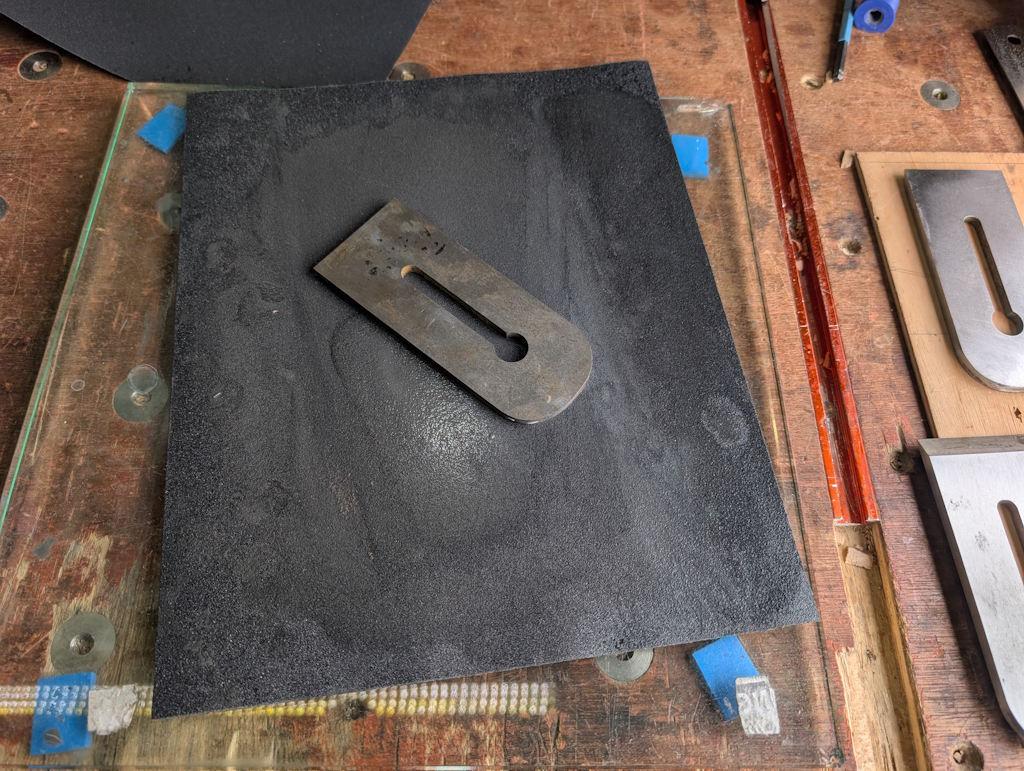
I used that on both faces and all the way round the rim but didn't touch the bevel at this point. I kept going until most of the surface was smooth but didn't try to get rid of every blemish (as I don't have the patience for that). The flat side then got rubbed on 240 grit wet-and-dry paper. The aim here is to get rid of all the 120 grit marks and leave a smooth surface near the cutting edge.
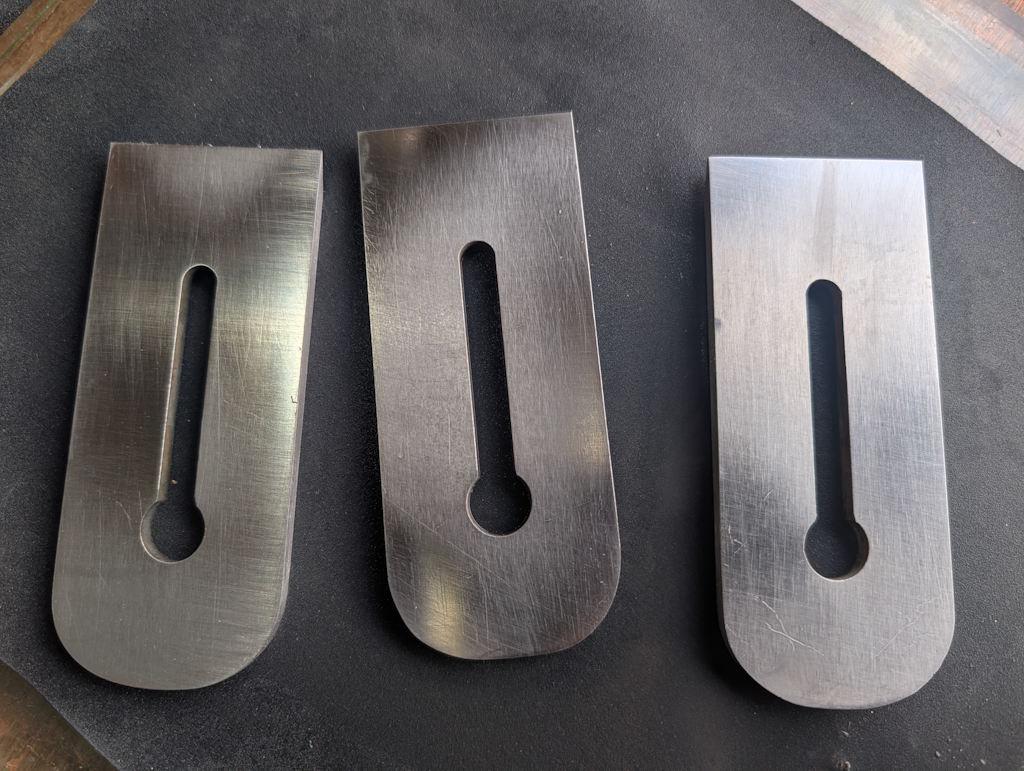
In practice, what happens is that it'll either get ground at the tip and at the back or it'll get ground in the middle. The former case is good; in the latter case I keep going until it's at least most of the way to the tip. In the following photo, the two on the right are what I consider to be good enough. The one on the left isn't great (as there are still some coarse marks in the middle of the tip area) but it'll do.
Next up is some work on my medium speed bench grinder, to prepare the bevel. This proceeds quite quickly, with the blade being dunked in some water as soon as the blade starts to feel even slightly warm.
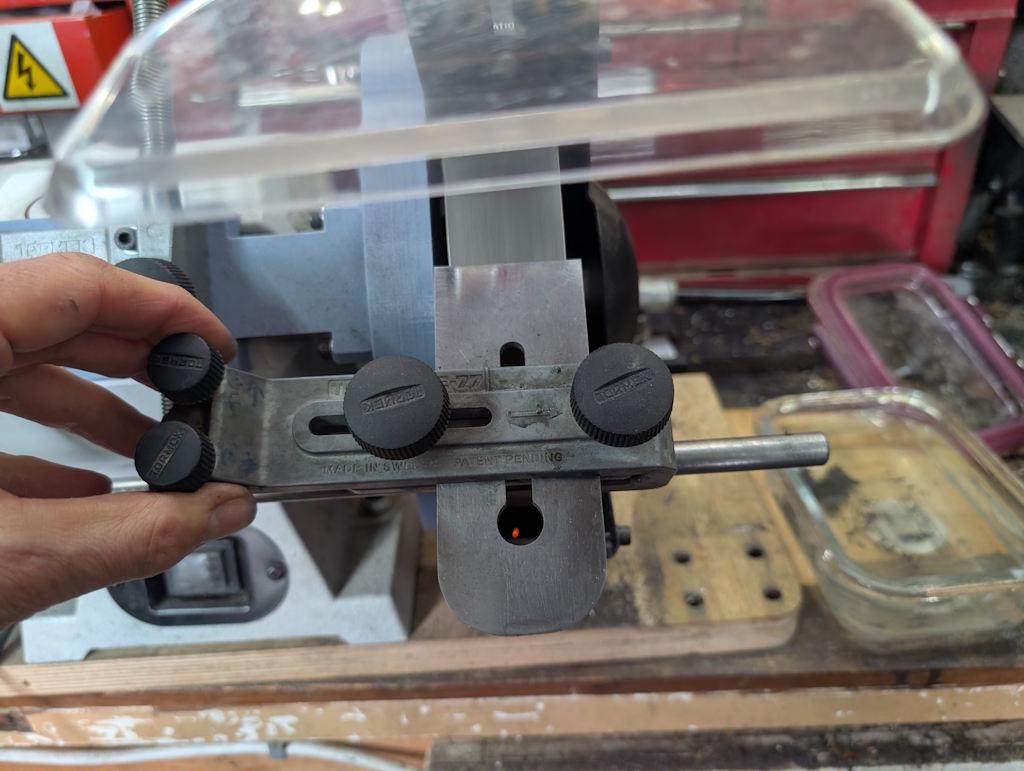
Looking at that photo, the blade tip looks a bit red (albeit a bit of a weird shade). That's not a heat effect, I think it's probably a reflection of something.
This is what it looked like when the grinding was nearly done:
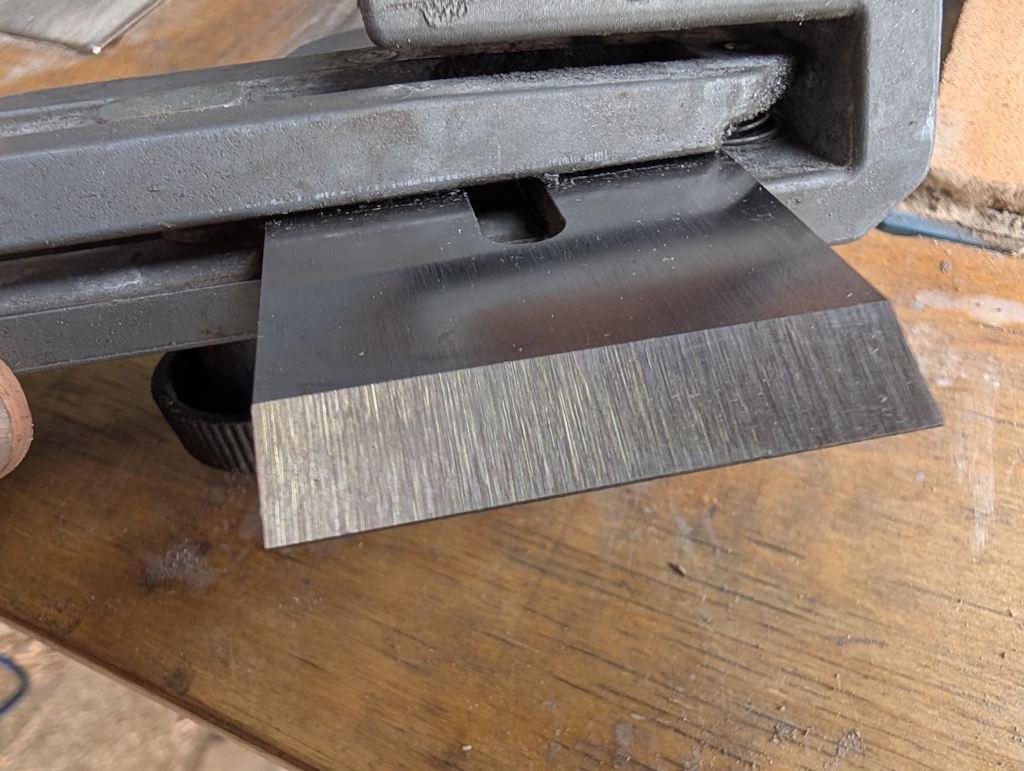
If you look closely you can see there's still a very slight flat end, so a bit more grinding was needed to remove that.
With the grinding complete it was over to the bench stones:
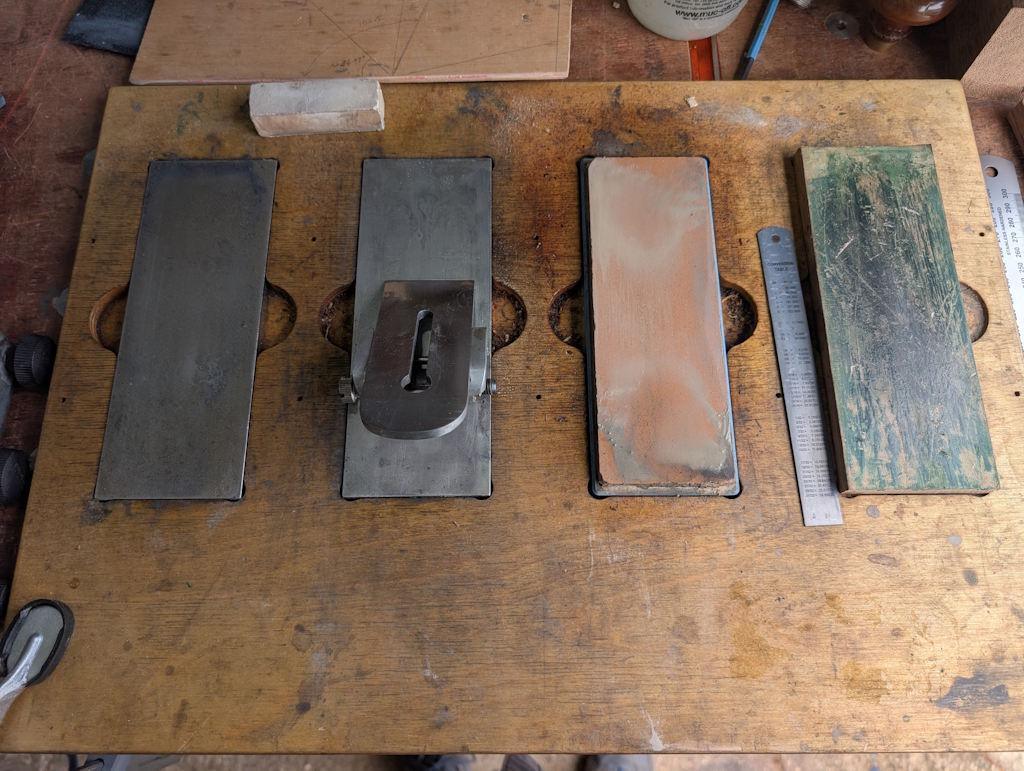
There are a lots of ways of sharpening. As long as you get a sharp edge then your method is fine. This is just my method.
I use an Eclipse #36 honing guide, which I find is the quickest option for preparing bevels where there's a reasonable amount of material to remove (and I find it no slower than doing it by hand for normal sharpening). While putting the blade into the guide adds a bit of time (of the order of 15 seconds) to the process, I can move the blade back and forth on the stone at about 3 to 4 times the speed than I can when doing it unguided. As a result, the actual time on the stones is much shorter and that compensates for the jig set-up time.
After working through the three stones - a "coarse" diamond stone (equivalent to 325 grit I think), an "extra" fine diamond stone (equivalent to 1000 or 1200 grit I think) and an 8000 grit waterstone (which unlike the coarser waterstones doesn't need the tedious and messy step of soaking it in water, just spraying it is enough) - I plonk an old steel rule down on the waterstone and use David Charlesworth's trick to make sure the very tip is polished despite the slightly rough grinding in the earlier photo:
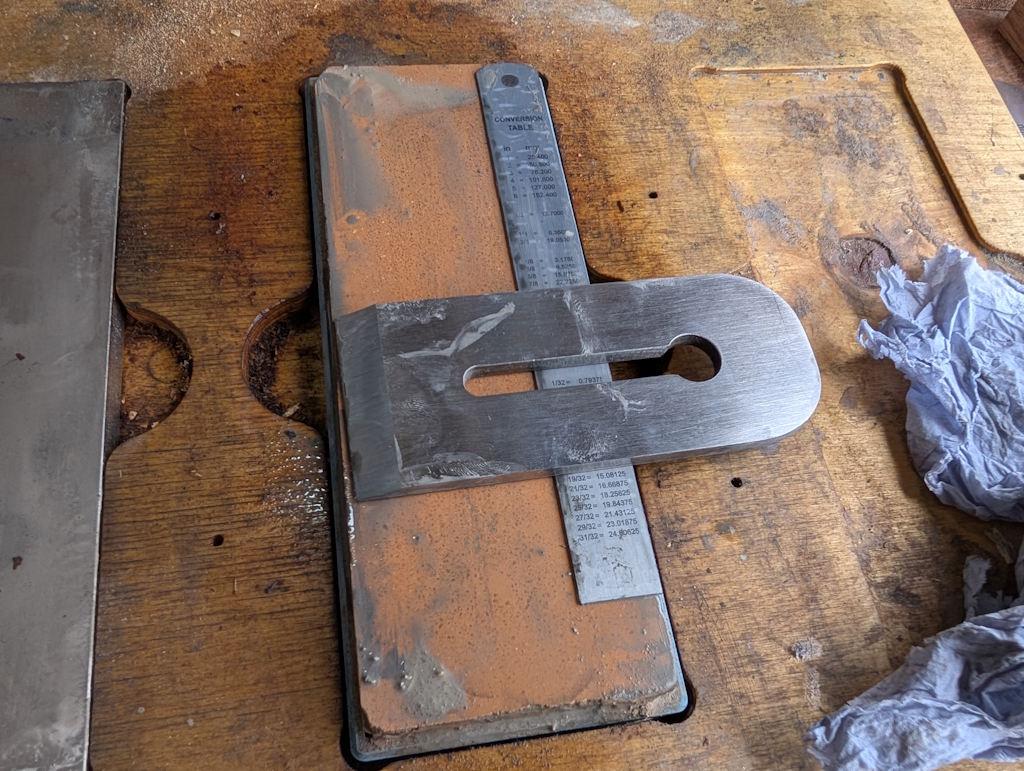
This is what the ruler trick does to the back:
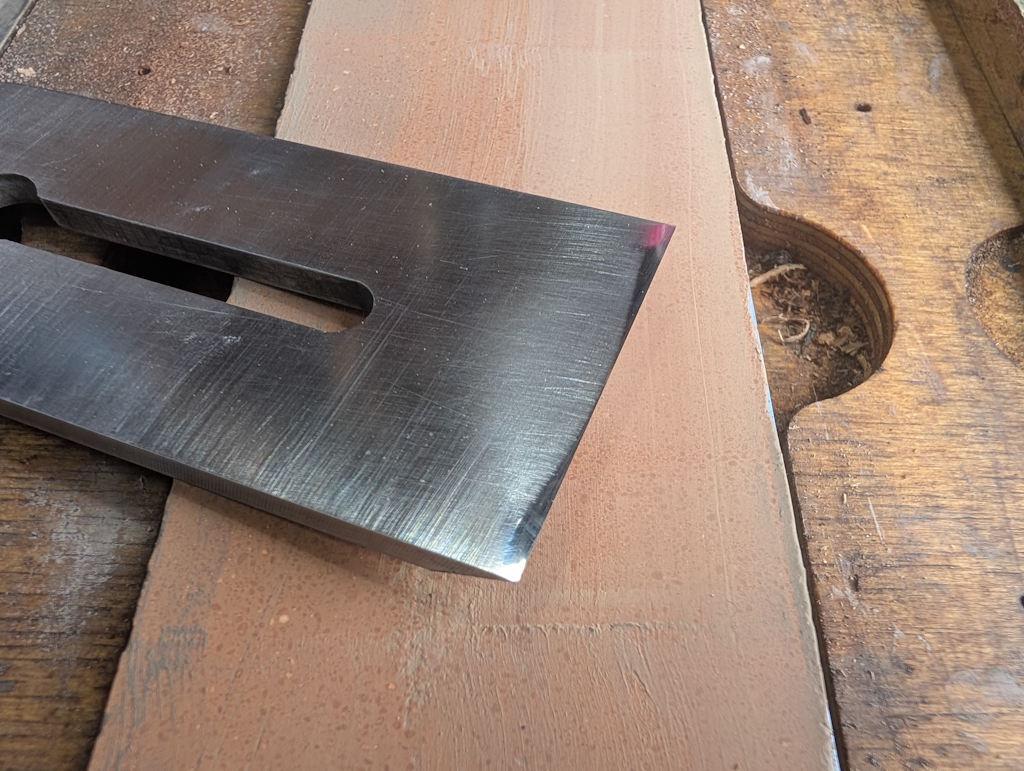
This is the blade with the slightly lower middle section (because I stopped flattening before it went all the way to the tip). You can see that the polished edge only just makes it to the tip in the central section (whereas at the edges it goes further back). Only just getting to the edge is enough as it's only the very tip that cuts.
The blade then gets stropped on the leather pad and is ready to cut:
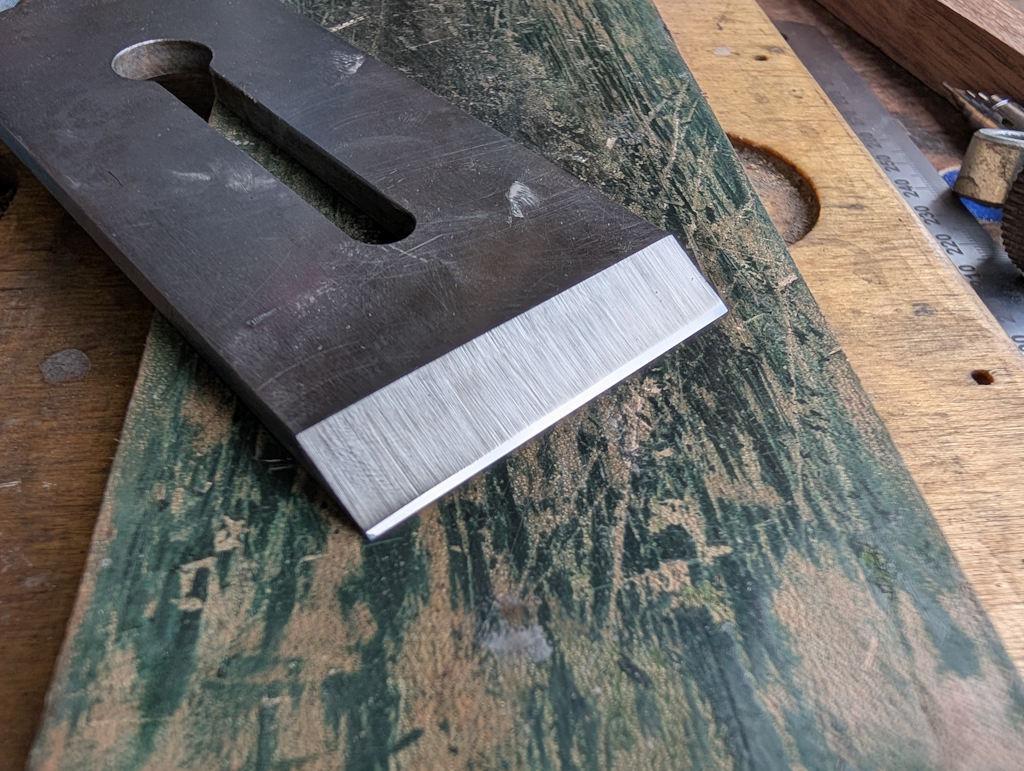
It'll probably go back to the waterstone later to have a bit more attention on the bevel with more pressure on the outer edges (to add a very slight camber). For now I've just sharpened it straight across so any out-of-squareness of the blade fitment in the plane body will result in scratches from the corners of the edge. For now it's good enough to prove that the blades cut:
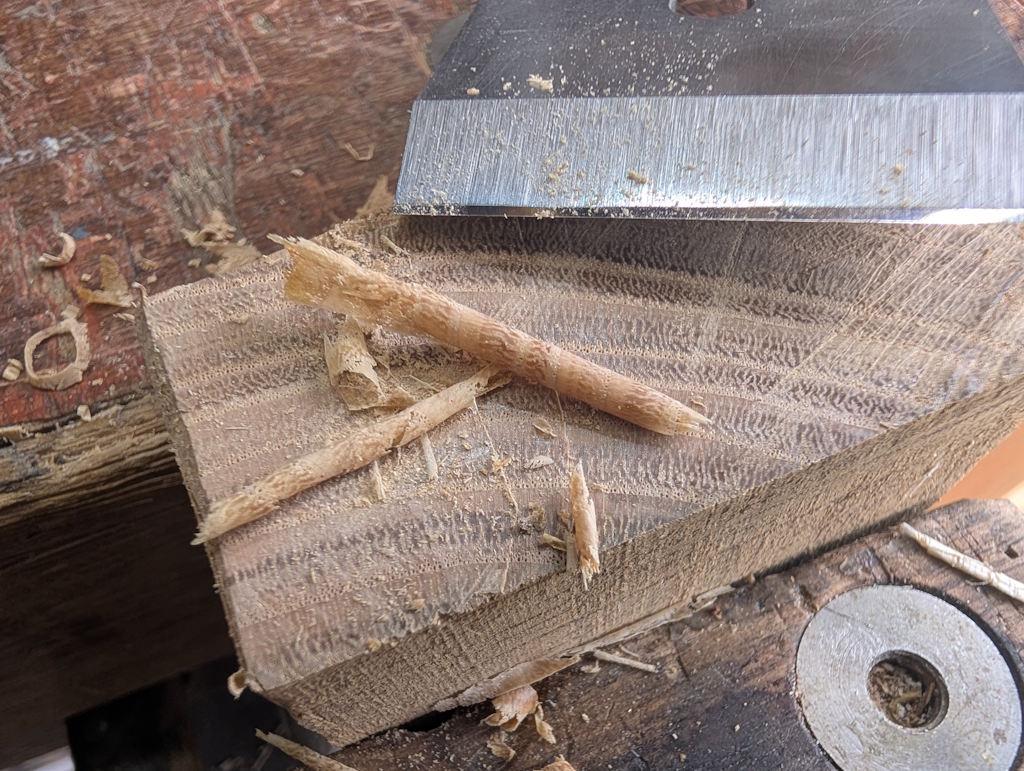
That was just a quick test freehand on some end grain (I think it's Sweet Chestnut). Plane blades aren't the most ergonomic thing to use freehand but it cut easily and that's good enough for me.
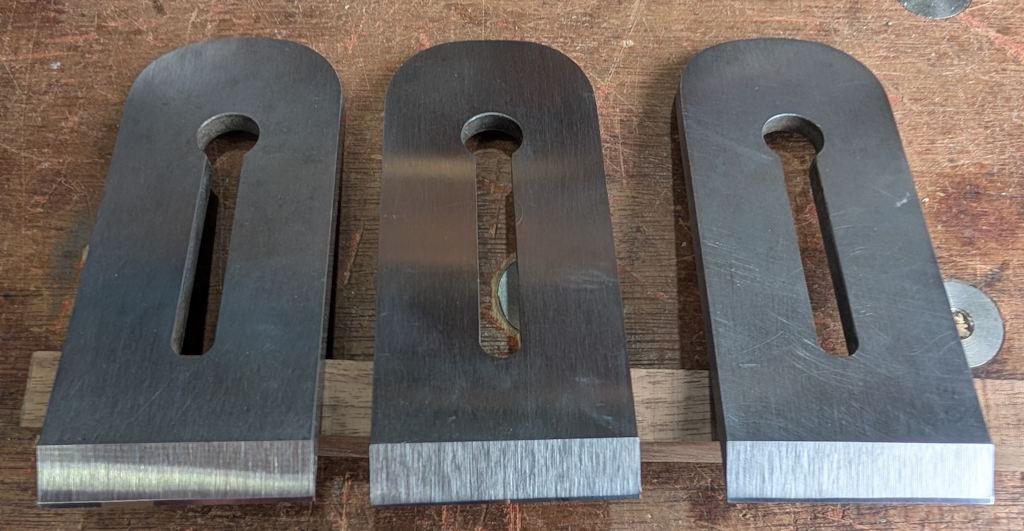
All three blades are finished, give or take any cambering or whatever I decide to do later:
Page 6 of 25
This website is free and ad-free, but costs me money to run. If you'd like to support this site, please consider making a small donation or sending me a message to let me know what you liked or found useful.